

Charging at home is the best part of owning an EV: you leave every morning with a full battery and stop thinking about gas stations entirely. Getting there means one real electrical project — putting the right charger on the right circuit — and it's worth understanding before the quotes roll in.
The good news is that none of this is exotic. A home charger is a 240-volt appliance circuit, the same family as your dryer or range, just sized for a heavier continuous load. Here's what actually matters, with real 2026 numbers.
Level 1 is the cord that comes with the car, plugged into a standard 120-volt outlet. It adds roughly 3 to 5 miles of range per hour, which is fine if you drive under 30 miles a day and park at home every night. It costs nothing to set up, and for plenty of commuters it's genuinely enough.
Level 2 runs on 240 volts at 32 to 48 amps and adds 25 to 40 miles of range per hour. A nearly empty battery refills overnight instead of over three days. If you drive a lot, own two EVs, or just hate range math, Level 2 is the answer — and it's what the rest of this guide covers.
Your panel has a fixed budget — most US homes have 100, 150, or 200-amp service. A 48-amp charger lands on a 60-amp circuit, which is a big new line item on top of HVAC, range, and dryer. The question isn't whether there's an empty breaker slot; it's whether the panel can carry the total load.
The honest answer comes from a load calculation per NEC Article 220, which takes an electrician under an hour. If you're close to the limit, you don't automatically need a bigger panel: a load-management device pauses charging when heavy appliances kick on, or you can simply run a smaller 32-amp charger. On an older 100-amp panel, though, budget for a possible service upgrade.
EV charging counts as a continuous load, so NEC Article 625 requires the circuit to be sized at 125% of the charger's output. A 40-amp charger needs a 50-amp breaker; a 48-amp unit needs 60 amps. That's also why you can't tap an existing dryer circuit and call it a day.
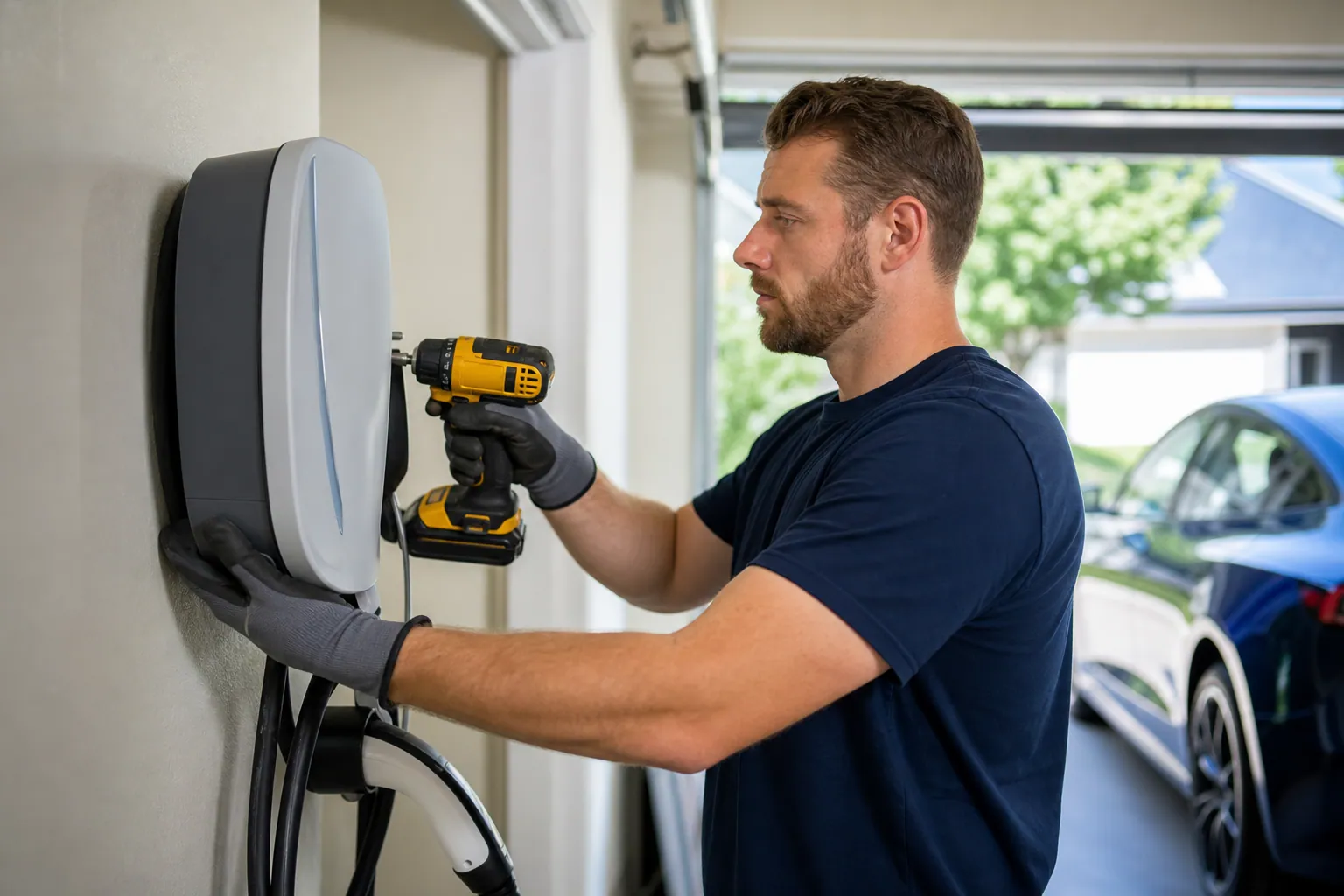
Wire size follows from there — 6 AWG copper is typical for a 50-amp run, heavier for 60 amps or long distances. Hardwiring is cleaner and required above 48 amps; a NEMA 14-50 receptacle works for plug-in units but needs a GFCI breaker under the 2023 NEC. Opening a live panel to land the new breaker is the one genuinely dangerous step, and it's the part a licensed electrician — the kind of work Acme Electric does every week — should own.
The charger itself runs $350–$800 for a solid name-brand 40- to 48-amp unit. Labor and materials on top depend almost entirely on the distance from your panel and the panel's condition.
Most straightforward installs land between $1,200 and $2,200 all-in, hardware included. Get two or three quotes and make sure each one states the breaker size, wire gauge, and whether the permit is included.
A new 240-volt circuit requires an electrical permit in nearly every US jurisdiction — usually $50–$250 — plus a short inspection once the work is done. Your electrician normally pulls the permit and folds it into the quote.
This isn't just box-checking. An unpermitted install can void the charger's warranty, complicate a home sale, and hand your insurer an argument if that circuit is ever involved in a claim.
The federal 30C credit — 30% of install costs up to $1,000 — expired for installations completed after June 30, 2026, so if yours wrapped up before then, claim it at tax time. Beyond that, what's available depends on your ZIP code.
Many utilities pay $250–$1,000 rebates for installing a networked Level 2 charger, and several states stack incentives on top. Also ask about a time-of-use EV rate: charging off-peak at $0.08–$0.12 per kWh often saves more each year than any one-time rebate.
Mounting the charger and running cable is within reach for a careful DIYer. The expensive failures come from the same handful of shortcuts, over and over:
If you take one thing from this guide: hardwire the unit or buy an industrial-grade receptacle, size everything at 125%, and get the inspection. Done right, a Level 2 charger is a 20-year appliance that makes EV ownership boring in the best way.