


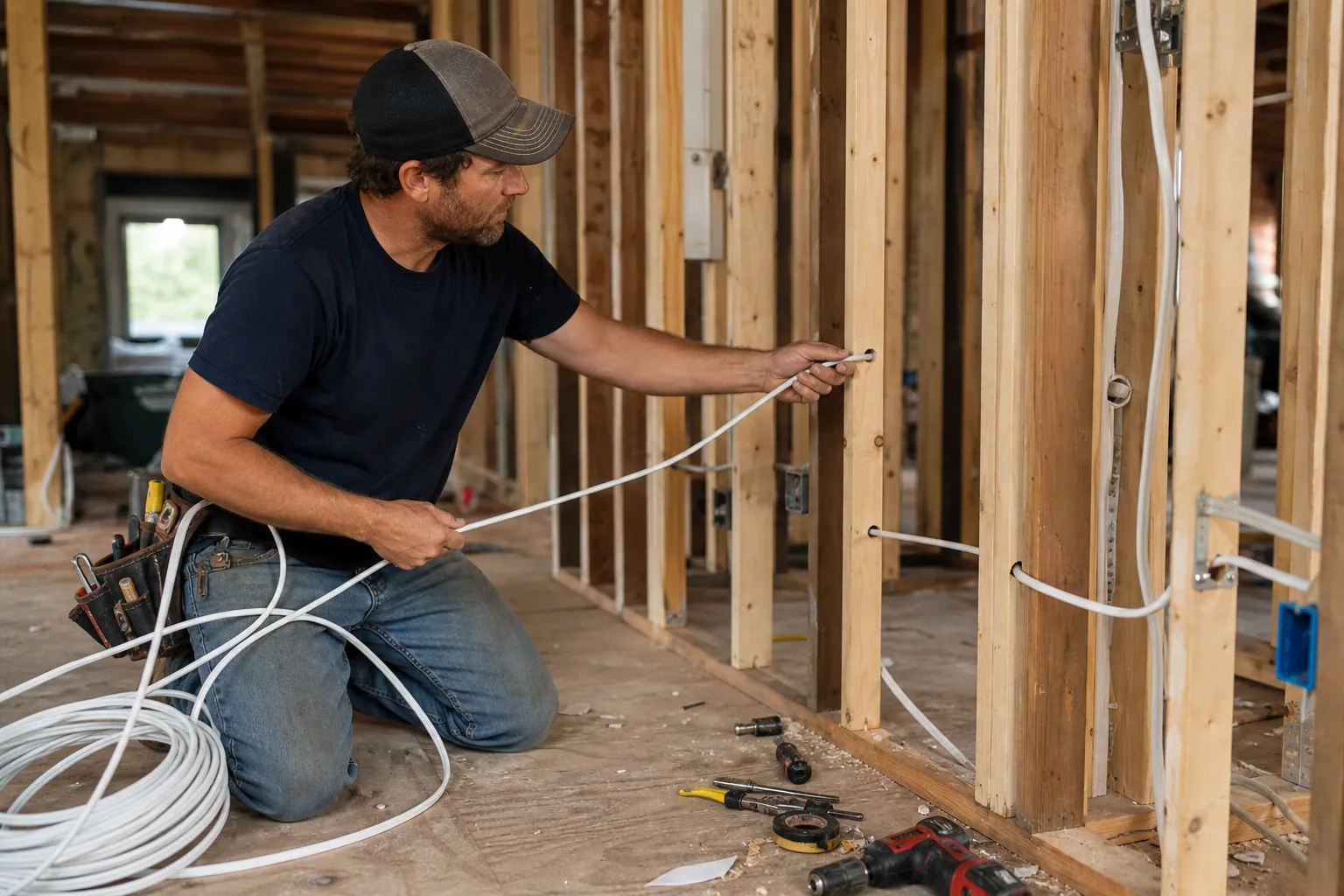
Rewiring a house in 2026 runs anywhere from about $6,000 for a small ranch to north of $30,000 for a big two-story with plaster walls. That spread is honest — the price depends more on your walls, your panel, and your local permit office than on the wire itself. Here's how the numbers actually break down.
One thing up front: "rewire" means different things to different contractors. In this article it means replacing all the branch wiring — the cable running from your panel to every outlet, switch, and fixture — plus new devices and usually a panel upgrade. Make every bidder define it the same way, or you can't compare quotes.
Most full rewires in 2026 land between $4 and $10 per square foot, labor and materials included. Copper has gotten pricier over the last few years, and electrician labor runs $60 to $130 an hour depending on your market, so big coastal metros sit at the top of every range below.
Add $2,000–$4,500 if the job includes a 200-amp panel upgrade, which most full rewires do. If the service entrance cable and meter base need replacing too, budget another $1,500–$3,000.
Access is the single biggest variable. A one-story house with an open attic and a crawl space lets an electrician fish new cable with minimal drywall damage. A two-story on a slab with plaster walls means more holes, more hours, and a patching bill at the end.
The cheapest time to rewire is during a renovation, when the walls are already open — that can save 25–30% versus fishing cable through finished walls. An empty house between owners is the next best window.
If your house was wired in the mid-1970s or later with grounded copper NM cable, the wiring itself is usually fine. You may only need new circuits for real loads — a kitchen remodel, a heat pump, an EV charger — not a gut job.
Partial work makes sense when the problem is contained. Knob-and-tube that survives only in the attic, or an addition wired badly in the '80s, can be rewired as a zone for $2,000–$6,000. Single rooms typically run $800–$3,000 depending on access.
Aluminum branch wiring from the 1960s and '70s is a special case: instead of full replacement, approved connector retrofits (COPALUM or AlumiConn) at every termination often solve it for $1,500–$4,000. Code doesn't force you to upgrade circuits you aren't touching — but anything new has to meet the current NEC.
A whole-house rewire requires a permit almost everywhere in the US, typically $200–$900. The inspector checks the rough-in before walls close and the finished work after, verifying things like AFCI protection on bedroom and living-area circuits (NEC 210.12) and GFCI protection in kitchens, baths, garages, and outdoors (NEC 210.8).
Skipping the permit isn't a savings. Unpermitted electrical work can void a homeowner's insurance claim after a fire, and it will surface during a home sale — where you'll pay to have it inspected and corrected under deadline pressure.
Panel swaps and service work also happen on or next to live equipment, and that part genuinely belongs with a licensed electrician like Acme Electric, who pulls the permit in their own name and schedules the inspections for you. If a contractor asks you to pull the permit as a homeowner, that's a red flag, not a favor.
When one bid comes in 40% under the others, something is missing from it. Usually it's one of five things: no permit, no wall patching, a reused undersized panel, fewer circuits than the house needs, or standard breakers where code requires AFCI.
That last one is real money. AFCI and dual-function breakers run $45–$65 each versus about $8 for a standard breaker, so across 20 circuits a lowballer saves $900 by quietly leaving them out — and the work then fails inspection, or never gets inspected at all.
Fixing a botched rewire costs more than doing it right once, because the second electrician has to trace and undo the first one's work before adding anything. Overloaded shared neutrals and buried junction boxes are the classic finds.
Get three itemized bids and make them answer the same questions. You're not looking for the lowest number — you're looking for the bid that defines the job completely.
A full rewire is a once-in-50-years job. Paying mid-range for a documented, permitted, inspected installation is cheaper than paying twice — and it's the version that helps, not hurts, when you sell the house.