

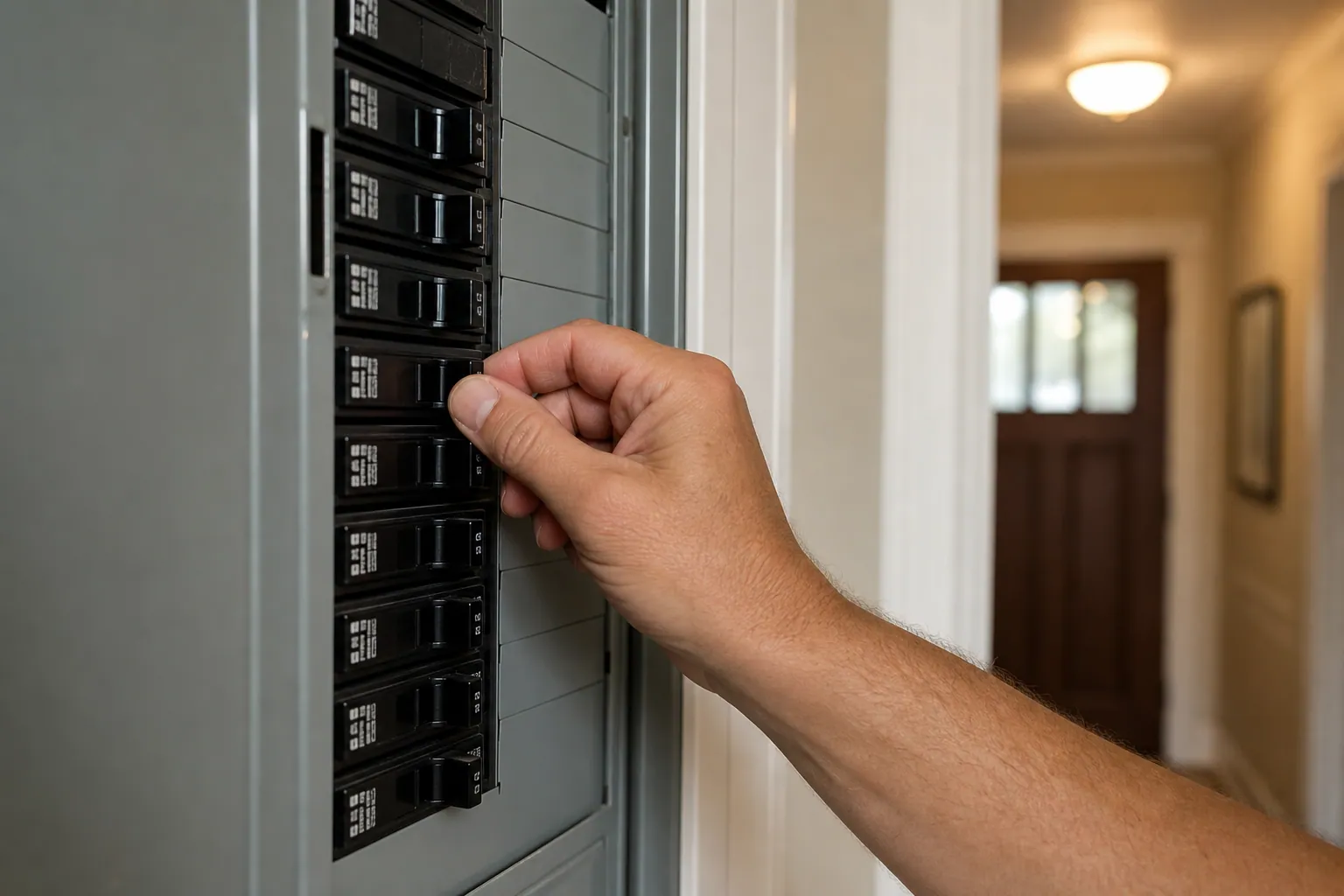
A breaker that trips once in a blue moon isn't broken — it's doing its job. Every breaker in your panel is sized to the wire behind it, and it cuts power the moment current exceeds what that wire can safely carry. That split-second decision is what stands between an overheated cable and a house fire.
But a breaker that trips over and over is sending you a message, and there are really only three messages it can send: overload, short circuit, or ground fault. Each one behaves differently, which means you can usually identify the culprit yourself — safely — before deciding whether it's a five-minute fix or a job for a pro.
This is the cause in probably eight out of ten cases. A standard 15-amp circuit delivers about 1,800 watts and a 20-amp circuit about 2,400 — and a single space heater eats 1,500 of that by itself. Stack a hair dryer, microwave, or window AC on the same circuit and the breaker warms up internally and trips, usually seconds to a few minutes after the load kicks in.
The NEC is even more conservative than the raw numbers: continuous loads (anything running three hours or more) are capped at 80 percent of the breaker rating, so a 15-amp circuit is really only good for about 1,440 watts of sustained draw. The tell for an overload is timing — everything is fine until one specific appliance starts, then the trip comes a little later, not instantly.
A short happens when a hot wire touches a neutral or another hot — resistance collapses to almost nothing and current spikes to hundreds of amps in a fraction of a second. The breaker's magnetic trip slams open immediately, which is why a short feels different from an overload: there's no delay at all.
The usual suspects are damaged appliance cords, a screw or nail driven through a cable in the wall, or a wire that has worked loose inside an outlet or switch box. You'll sometimes get a pop, a visible spark, or a sharp acrid smell at the moment it lets go. If a breaker trips the instant you reset it, stop resetting it — you're feeding a fault, not fixing one.
A ground fault is current escaping its intended loop — into a metal appliance case, into water, or worst case through a person. GFCI outlets and breakers are built for exactly this and trip at just 4–6 milliamps, thousands of times less current than it takes to trip a standard breaker.
That's why the NEC (section 210.8) requires GFCI protection in bathrooms, kitchens, garages, laundry areas, basements, and outdoors — everywhere water and electricity can meet. The classic case is an outdoor or garage receptacle that starts tripping after rain: moisture has gotten into the box or a cord end.
One cousin worth knowing about: AFCI (arc-fault) breakers, required in bedrooms and most living areas in newer homes. They occasionally nuisance-trip on brushy motors like vacuums and treadmills, but repeated AFCI trips with no obvious pattern can mean damaged wiring that is genuinely arcing.
You can diagnose most of this with nothing but the plugs in your hand. Work the problem in order:
Plenty. Redistribute the load — move the space heater to a receptacle on a different circuit, or run the toaster and the coffee maker at different times. Replace frayed cords and any appliance that trips every circuit it touches, and press the TEST and RESET buttons on your GFCIs monthly so you know they still work.
It also pays to know 2026 prices so you're not guessing when real work is needed: a swapped-out breaker typically runs $150–$300, a new GFCI receptacle installed is $120–$250, and adding a dedicated 20-amp circuit for that space heater or microwave lands around $250–$900 depending on the distance from the panel and whether walls are finished.
Some symptoms mean put the screwdriver down: a breaker that's hot to the touch, buzzing or crackling from the panel, scorch marks or a melted smell at an outlet, or a breaker that won't hold with everything unplugged. And never "solve" a tripping 15-amp breaker by installing a 20 — that breaker is protecting 14-gauge wire that can't handle the extra current, and oversizing it is how wiring inside your walls gets cooked.
Anything inside the panel itself — replacing breakers, tracing a short, adding circuits — belongs with a licensed electrician like Acme Electric, because the bus bars in your panel stay live even with the main breaker off. Everything up to the panel cover, though, is fair game: unplug, reset, observe, and you'll walk into that conversation already knowing what the problem is.